
Town of Montgomery Historical Directory Collections
No full Town-specific printed or reverse directory run was confirmed in the research. That is an important finding, not a reason to call a nearby-city volume Town-wide. The available Town historical trail uses Orange County volumes, regional shelves, newspapers, atlases, and library finding aids. Start by matching the historical place label and date to the collection's stated coverage.
| Collection | Years | Where held | Access |
|---|---|---|---|
| Vail's Orange County farmers and business directory | 1871/72 | NYPL, with HathiTrust record linked by NYPL | Catalog and online record; verify Montgomery entries |
| D.S. Lawrence & Co. Orange County directory | 1878/79 | NYPL Milstein Room/catalog | Historical residents and classified listings |
| OCGS Middletown and Port Jervis directories | 1899-1952, incomplete | Orange County Genealogical Society | Research-room collection |
| OCGS Newburgh-area directories | 1899-1956, incomplete | Orange County Genealogical Society | Research-room collection |
| Walden Citizen Herald | 1916-1925 | OCGS microfilm | Onsite newspaper research |
| Goshen Independent Republican | 1813-present, some missing | Goshen Local History Room | Obituary database begins in 1820 |
| Goshen Democrat | 1834-1933, some missing | Goshen library microfilm | Newspaper notices and local names |
| County atlases | 1875 and 1903 | NYPL / County historical resources | Landowner, road, and farm context |
| Montgomery Sanborn | 1924-1937; item dated 1937 | Library of Congress | Catalog item, not online; three sheets |
The NYPL Orange County directory catalog is the direct route for the known 1871/72 and 1878/79 county volumes and atlas records.
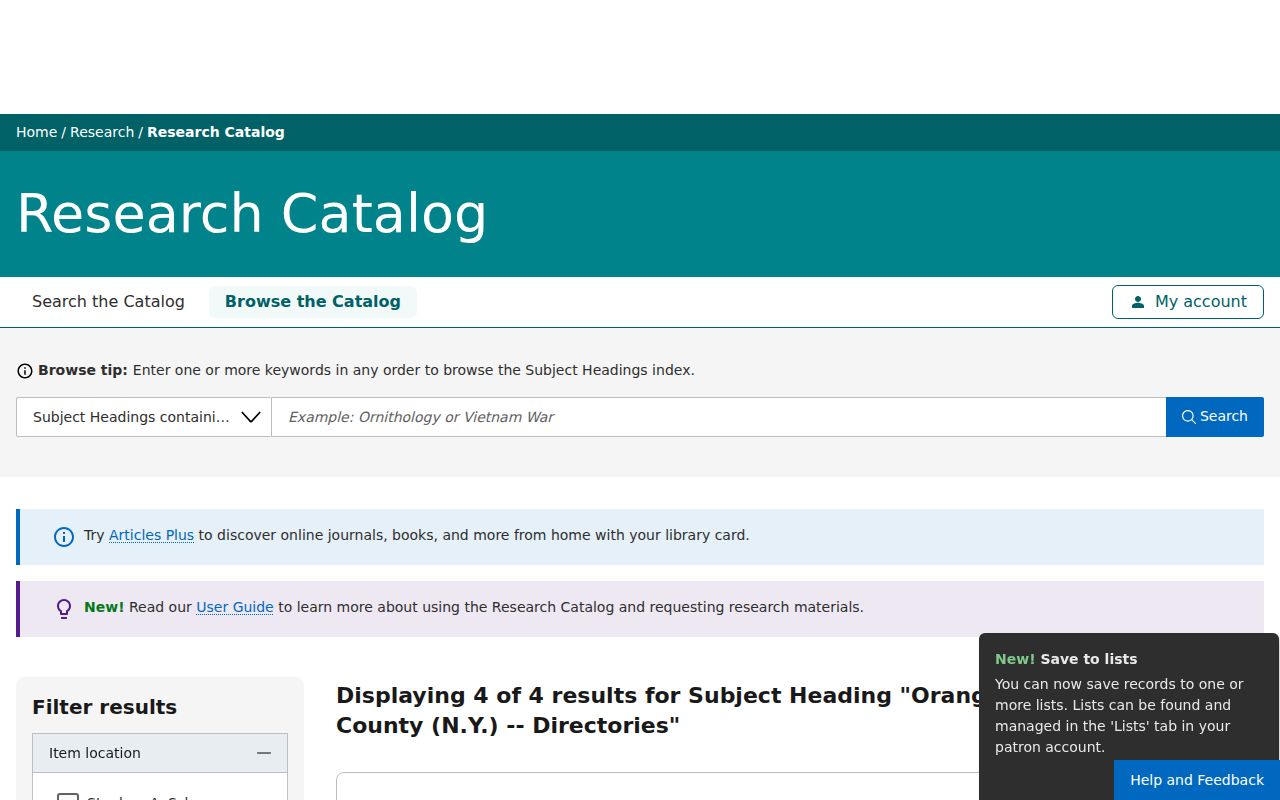
A catalog entry confirms a collection exists, not that every Town of Montgomery household appears in it. Check the title, geographic scope, edition, and image or shelf access before recording a search result.
Town of Montgomery Directory Coverage Gaps
Gaps are part of accurate Town historical-directory work. The OCGS city runs concern Middletown, Port Jervis, and the Newburgh area, and they are incomplete. Thrall's digital Middletown directory resource has no exact run confirmed in the research. Walden Public Library offers Citizen Herald Archive and local yearbooks, but an exact archive-year list and a complete reverse directory were not verified. These limits should appear in a research note beside any discovery.
Where a printed volume fails, shift to the fallback chain: first the library or society catalog, then onsite microfilm, newspaper and obituary tools, atlases, and the County Record Room. For an address-based question, the Town of Montgomery street directory method supplies the current parcel and deed chain rather than rebuilding the historical shelf here.
Do not read an absence as proof that someone was not in Town. A volume may omit a hamlet, use a business section, lack an issue, or reflect a different municipal label. Preserve the source spelling and ask the repository about related volumes.
Town of Montgomery Directory Research Rooms
The Orange County Genealogical Society research room at the 1841 Historic Court House, 101 Main Street in Goshen, holds the strongest county-specific layer. Its holdings include a master surname index, family files, county directories, census microfilm, deeds, mortgages, naturalizations, wills, probate, and newspapers. The room has two copiers, digital microfilm/microfiche readers with laser printers, and copies cost 10 cents per page. Its Dan Burrows directory-of-directories guide is especially useful when a Town run has not been established.
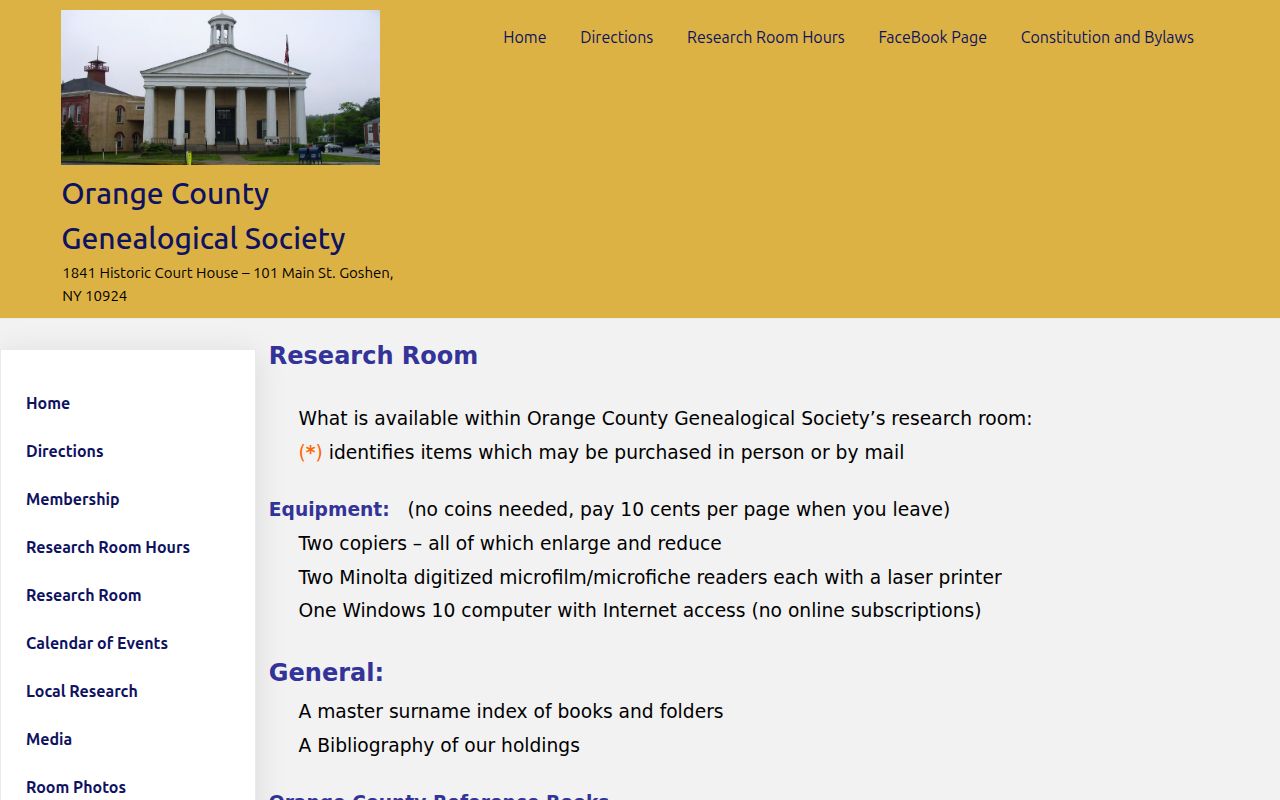
OCGS gives a Town historical-directory search a practical cross-check: a surname finding can be compared against historical deed grantor-grantee microfilm, census material, probate, or a newspaper rather than standing alone.
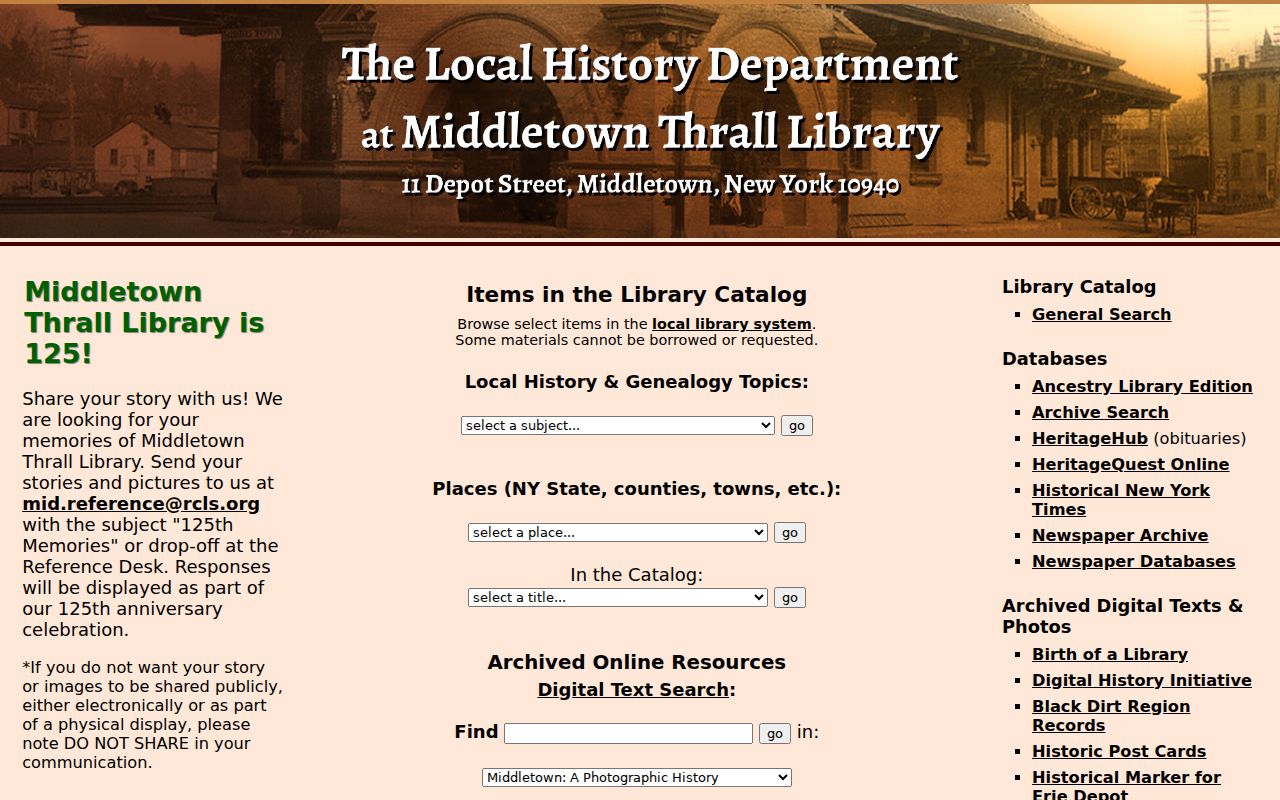
Thrall Library in Middletown is another regional route. Appointments are strongly recommended. Its local-history holdings include printed directory volumes, church and cemetery material, an obituary database, Orange County history, newspapers on microfilm, and local people, place, and event files. Some licensed databases are controlled at the library, so ask the reference desk about in-library access instead of assuming a remote login.
The Thrall Local History page below identifies the library's regional historical resources and its obituary and microfilm layer.
For a formal fallback, Goshen Local History Room accepts a research request at $15 per hour plus postage, with copies at $0.25. It is useful for its newspaper, map, manuscript, obituary, and marriage resources when a local shelf is not open online.
Read a Town of Montgomery Directory Entry
An entry should be captured as a dated record, not reduced to a name and a street. The research did not open a live scanned Montgomery entry, so there is no verified local abbreviation code to reproduce. Instead, record the visible fields and photograph or transcribe the volume's own abbreviation key before interpreting a mark.
| Surname and given name | Keep initials, variants, and source spelling exactly as printed. |
|---|---|
| Occupation or category | Note whether it appears under a resident, business, farmer, or classified heading. |
| Address | Record the street, village or hamlet label, and any road or farm name. |
| Household or business designation | Identify whether the entry appears to describe a household, workplace, or organization. |
| Page, volume, and year | Preserve all three so another researcher can reopen the same entry. |
| Cross-reference | Capture any “see” reference, reverse section, or nearby spelling variant. |
- Criss-cross directory
- A directory arranged by address or street. It can support an address clue but may not exist in a given collection.
- Householder index
- An index organized around the person or household named in the volume, rather than a map or parcel.
- Abbreviation key
- The volume's explanation of its shorthand. Use the key printed in that edition instead of importing codes from another directory.
A business listing is not automatically a household listing. Likewise, an occupational detail identifies the entry's context, not a conclusion about a person's home. Dated directory evidence gains value when it is paired with a page image, an atlas, deed, census, or notice from the same period.
Town of Montgomery Directory Cross-Checks
Use names and addresses in both directions. Search the name section, then search an address or road in any available street-order section. A person may appear as an initial, under a spouse's surname, or under an older village label. County directories can combine residents, farmers, merchants, public offices, and classified businesses, so the section heading belongs in the citation.
The 1875 and 1903 atlas layer can supply a named landowner, farm, road, or parcel-era geography when a Town directory gives only a loose location. It does not prove that the landowner lived there. A recorded deed or census is a stronger check for title or household context. Newspapers add dated notices but should not substitute for a vital record.
OCGS microfilm includes federal census for Orange and adjacent counties from 1790-1880 and 1900-1930, plus New York state census material from 1825-1875 by town without an index. County guidance says the 1825-1875 books are not online at capture and are available through the Record Room.
Town of Montgomery Directory Place Names
Historic place names change how a Town directory entry is found. The Village of Montgomery developed from Ward's Bridge and an early rectangular street plan associated with James Clinton. Bridge, Clinton, and Union streets are address-history clues, but an old wording should not be silently converted to a current address. Compare the source date, atlas, and current GIS label.
The Town also contains the villages of Montgomery, Walden, and Maybrook. A source using “Montgomery” may point to a village, the broader Town, a postal designation, or a historical place label. Earlier records can also reflect boundaries that later became part of Crawford or Hamptonburgh. Search both the historic and modern terms, then state the source's own geography in the finding.
Trace a Town of Montgomery Directory Household
A good household trail links years rather than treating one printed appearance as a life summary. Begin with a stated name, approximate date, or address, then move outward only when the next source agrees with the place and time. This approach works whether the lead comes from an 1870s county directory, a Walden newspaper, or a regional collection.
- Identify the earliest likely entry and record its full citation, spelling, entry type, address, and page.
- Check the next available year or regional volume, noting whether the name, address, and category remain consistent.
- Pair the time period with a census roll, using the Town-organized state-census material or federal microfilm where coverage fits.
- Use the 1875 or 1903 atlas and a deed description to test a road, farm, or landowner reference.
- Close a gap with Goshen, Walden, or Thrall newspaper and obituary resources, labeling the result as a notice rather than a certificate.
A disappearance can mean a move, a death, a changed spelling, an omitted issue, or a change in the collection's geography. The correct next step is comparison, not a guess. Town historical directories are strongest when the archive location and coverage limits travel with the finding.
Note: A directory, atlas, obituary, and deed can describe different relationships to the same place, so each should keep its own date and evidence label.
Town of Montgomery Historical Directory History
Orange County's record trail reaches well beyond a single printed directory. County historical resources identify deed grantor-grantee material from 1703 to 1900 and mortgage material from 1703 to 1869. OCGS adds court minutes, naturalizations, probate, surnames, newspapers, directories, and family papers. That layered shelf can bridge a 19th-century Town of Montgomery name when a printed volume is missing.
Montgomery became a township in 1788, with the village incorporated in 1810, Walden in 1855, and Maybrook in 1926. Those dates do not create directory coverage, but they help explain why a historical source may use a village or predecessor boundary rather than the Town name used today. The Library of Congress Sanborn item is a building and street-context lead, not a resident source, and its catalog page states that the item is not online.
Town of Montgomery Directory Limits
Old printed directories are historical collections, not a current list of Town residents. They can omit people, use a business address, identify a nearby municipality, or preserve an old road or postal term. A modern record should be checked through the correct custodian, while a historical entry should keep the collection, year, page, and source spelling intact.
Do not use a historical household trail to expose private information or defeat a protected address. The useful output is an evidence trail: repository, source date, page, exact printed field, and a clear limitation note.